After the autumn's record influx, it seemed inevitable that the odd Pine Bunting would be unearthed in the British countryside this winter. By the end of 2016 that inevitability had not yet materialised, but it was on New Year's Day that a female was found at Venus Pool, Shropshire. Unfortunately it proved extremely elusive and was seen well only the following day; it was reported on subsequent dates but always briefly and many left the site having dipped.


Pine Bunting, along with Aquatic Warbler, has sat at the top of my 'most wanted' list of birds to see in Britain for years now. I dipped the Choseley bird twice back in the day and, unable to get a lift to Worcestershire in 2005, it's been a long wait for another. I've always found it an interesting species - females are subtle (thus providing a genuine identification challenge), there's always the hybrid issue to consider and overcome, and males in particular are really dapper birds. It's also one of those species that you feel anyone has a fighting chance of finding given their penchant for turning up at otherwise uninspiring inland sites. The problem these days, as much as any other, appears to be finding flocks of their fast-declining western counterpart, Yellowhammer, to search through. It's quite depressing how depleted this species is in the British countryside even compared to when I started actively birding in the early to mid-2000s, when its populations were already severely reduced from historical levels.
New Pine Buntings have been popping up all over Western Europe on what seems like a daily basis this January, and another in Britain never seemed far away. Step forward Chris Gomersall, who did a fine job by pulling out a stunning male from among a big Yellowhammer flock at Dunnington, just east of York, on Friday. The bird showed a few times over the Saturday and so I decided to head for the site early on Sunday in order to try my luck. The main problem was that I didn't have my telescope, and this was most definitely a 'scope job. On arrival a big crowd of birders were looking in to a rough field at several hundred metres' range - not something my 8x bins were ever going to deal with!
After a nice catch-up with Andy and Vicky I decided to make use of myself and head off to explore the surrounding fields, in the hope that I might stumble across birds that were remotely close enough to check with binoculars. The sheep field where the bird had been seen on Saturday seemed a good place to start. Quite amazingly, no one else was looking and so I carefully walked the field edge, sifting through the various species feeding in the field or sitting in the hedgerows - there were plenty of Yellowhammers, a few Reed Buntings, various finches and lots of winter thrushes.
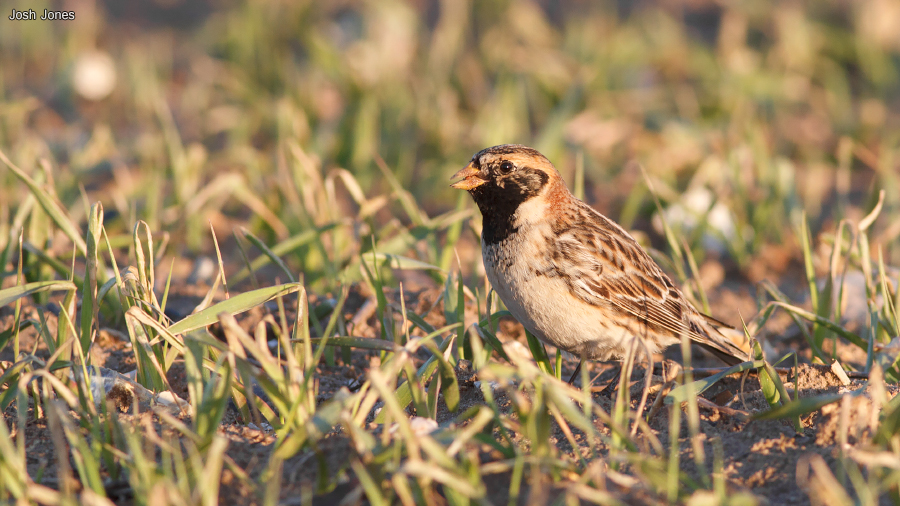
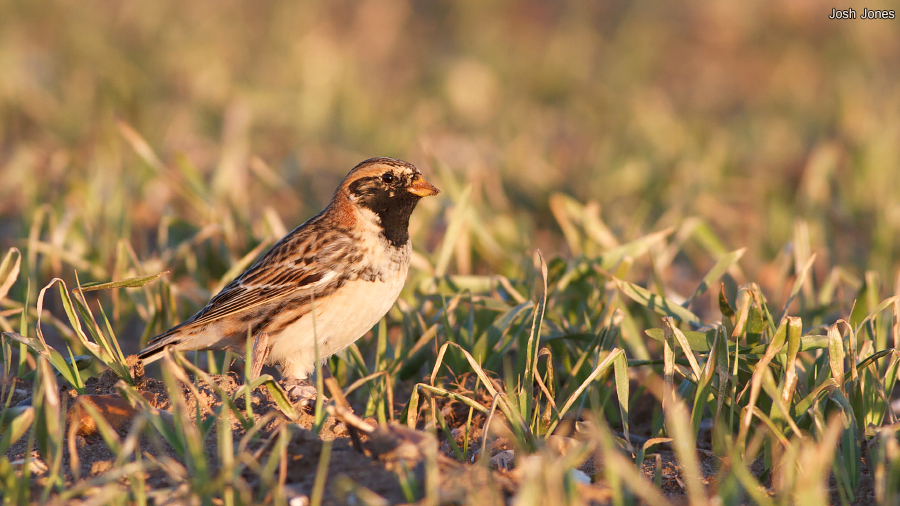
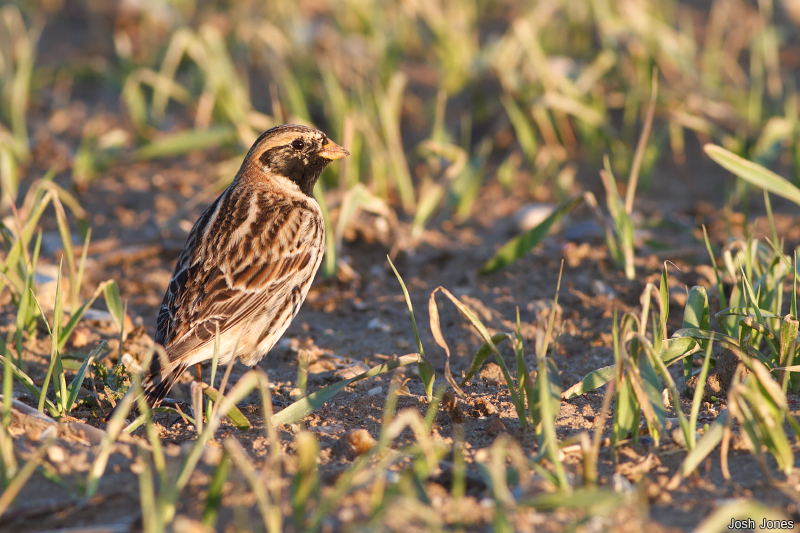
The whole place seemed very 'birdy' and undisturbed, so I decided to sit down by the fence. This caused the sheep to spook and consequently flushed everything up in to the trees, but soon enough birds started dropping back down. I sat there for about 10 minutes before, suddenly, an unmistakable brown-and-white head pattern appeared among a small group of Yellowhammers at 50 metres' range. No doubt that it was the male Pine Bunting, and in fantastic light too! The bird was extremely wary and mobile - even the excited reach for my camera caused the flock to pop back up in to the trees - but soon it came back down. I made a few calls to friends in the main crowd and awaited their arrival.
Uncropped (top) to ultra-cropped versions of the same shot ... the Dunnington Pine Bunting
I had a few brief views over a five-minute period, with the bird landing no more than 20 metres away at one point. Unfortunately it sat still, facing away, for about five seconds before bolting off again. If only it'd fed there for a little longer and turned to profile..!
The number arriving birders was never going to help - the increased movement and commotion clearly wasn't to the feeding flock's taste and they quickly moved away down the hedgerow, back west towards the original field. I always find bunting flocks can be very nervy and thus the utmost care needs to be applied when trying to watch them, even when on your own. The birds were very edgy with just me there, so it's no real surprise that they moved off when more started to arrive. A shame, but I think the bird was seen on back over in the other field on a couple of occasions shortly afterwards. Clearly this is a challenging bird to see but the corner of the field at 53.9679, -0.9678 seems to be a good area for feeding birds, and is well worth focusing on if visiting in the coming days. The Yellowhammers (and Pine Bunting) spent most of their time feeding around the fallen tree about 30m along the hedgerow running WSW back towards the farmhouse.
Given the autumn's arrival and the numbers just over the Channel in e.g. the Netherlands, there must be so many out there waiting to be found in unsuspecting patches of the British countryside. Hopefully a few more individuals of this brilliant species might be found before spring.
Given the autumn's arrival and the numbers just over the Channel in e.g. the Netherlands, there must be so many out there waiting to be found in unsuspecting patches of the British countryside. Hopefully a few more individuals of this brilliant species might be found before spring.