Leaderboard
728x15
Affichage des articles dont le libellé est may. Afficher tous les articles

Mallorca weekender

It had been over 15 years since I last visited Mallorca and a return visit was in order to connect with two specialities: Balearic Warbler and [Balearic] Tyrrhenian Flycatcher. Though I'd seen the flycatcher previously, this was as an uneducated 10-year-old and long before the potential split had been suggested, so it was as good as a tick.

I found the island to be much busier and more developed than when I'd previously visited with my parents in the 90s/early 2000s. There were also literally thousands of cyclists! Of course by no means a bad thing, but quite extraordinary to see so many people dedicating time to this ever-more popular hobby. It also meant you had to be pretty careful driving around corners on the winding mountain roads ...

Despite the increased development, many areas of the island remain beautifully unspoilt. It's always nice to see more traditional farming methods being practised and field edges full of Corn Buntings, Stonechats and larks (among others) - a stark contrast to the largely barren wastelands of the South Lincolnshire fens. The weather was also brilliant - although a little breezy on the Saturday, the sun shone throughout the weekend and the temperature was very pleasant in the low twenties (apart from at dawn, when it was positively chilly).

Bird-wise, I struggled a little with Balearic Warbler but eventually found a confiding bird at the Boquer Valley late morning on Sunday. Unfortunately the light was very strong by this time and my photos aren't what I'd hoped for on the outward journey (having dedicated two early mornings to finding them).


♂ Balearic Warbler, Vall de Boquer, 7 May

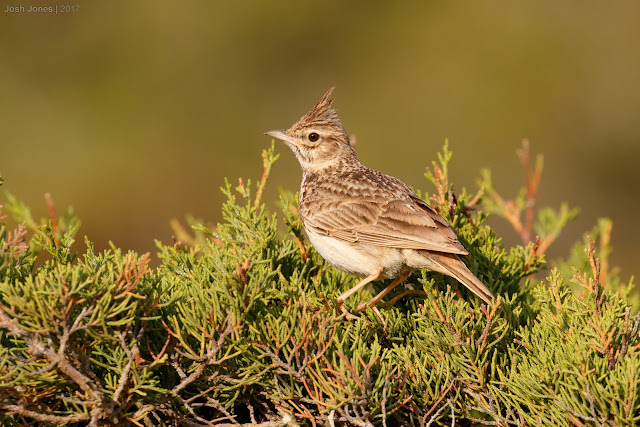
Occupying a similar niche to the warblers were both Thekla Larks and Tawny Pipits. I hadn't seen the former for a few years, and the views of the latter were perhaps the best I've ever had.


Migration wasn't as prevalent as it had been the previous weekend when, by all accounts, the island was littered with passerines after heavy storms. Nonetheless small numbers of nominate Spotted Flycatchers, Willow and Garden Warblers and a single Common Redstart were seen. Best passerine was a Melodious Warbler at Formentor lighthouse on the Saturday evening, apparently a fairly uncommon bird on Mallorca (but presumably overlooked?). I was also pleased to see a female Pallid Harrier over Portocolom on Saturday morning - I guess this would have been a big deal 10 years ago, but it seems to be recorded annually on Mallorca these days.

♀ Pallid Harrier, Portocolom, Mallorca, 6 May

It was also great to see a few Red-footed Falcons. I had three (ad ♂, 2cy ♂, 2cy ♀) at Vilafranca de Bonany and two (ad ♀, 2cy ♀) at Maria de la Salut. Heat haze was always a problem for photos as I saw both 'groups' in the middle of the day, but a few records below.

 Adult ♂ Red-footed Falcon, Vila Franca de Bonany, 6 May

 2cy ♀ Red-footed Falcon, Maria de la Salut, 7 May

Adult ♀ Red-footed Falcon, Maria de la Salut, 7 May

After seeing them fairly poorly in Corsica a few years ago, it was nice to reacquaint myself with the vocalisations and appearance of Moltoni's Warblers, with three singing males at Embalse de Cuber, as well as locally breeding Tyrrhenian Flycatchers there. Overhead in the mountains produced 20+ Griffon (these must be a recent thing on Mallorca - I never remember seeing them before?) and a handful of Cinereous Vultures and Booted Eagles.

Eurasian Griffon & Cinereous Vultures, Embalse de Gorg Blau, 6 May

It was a truly enjoyable couple of days away, and a cheap trip to boot - my return flight cost me £80 with Easyjet. I did the trip alone, but two or three up would make it an particularly inexpensive weekend trip, and very much recommended for some reasonable and relaxed birding in pleasant surroundings and weather.

Still looking at gulls ...

Quiet in the patch environs on Monday, save the common summer visitors that have arrived since my last intensive visit back in mid-April. Highlights were an Oystercatcher and this 3cy Yellow-legged Gull.


A little late to the party

After several days of northerlies, migration exploded back in to life on Sunday in quite impressive fashion. I moved house over the weekend and had no time to get out birding, this made all the more galling by the appearance of a Red-winged Blackbird on North Ronaldsay - which I knew I had absolutely no chance of doing anything about, even if I am a bit of a failed twitcher these days.

I was heading back to Lincolnshire on Monday to see family, so was quite excited to hit my old patch, Baston & Langtoft Pits - particularly as a moderate south-easterly was blowing when I woke up and, as I drove north, occasional showers were passing through. Actually, it turned out to be a bit of a disappointment with the best birds of the morning being two adult Whooper Swans flying north and a Bar-tailed Godwit flying through in the evening - not a patch on the previous day's dynamism, and I couldn't help but feel that I was a little late to the party. That said, 13 Dunlin was a figure virtually unimaginable here in the days I used to watch BLGP (wader habitat was always in limited supply compared to nowadays) and there were good numbers of breeding waders plus the usual singing warblers and a Cuckoo - no Turtle Doves though.

I visited Barnack's delightful Hills and Holes reserve with my mother late morning. I remember going here as a small kid and being thrilled by Marbled Whites, Six-spot Burnets and so on, and it's been a place I've treasured ever since. Clearly a bit early for the above insects (and rather cold too!), but a good carpet of Pasqueflowers, Cowslips and Early Purple Orchids.

Early Purple Orchid, Barnack, 1 May 2017

Someone had found a Black Redstart at Deeping Lakes earlier in the day so, after a family meal, I twitched it. An area tick for me, this was a fairly confiding (and very vocal) bird. Pintail was a good May record there and another Cuckoo was singing plus plenty of Common Terns over the main lake.


Black Redstart, Deeping Lakes, 1 May 2017

Back at BLGP early on Tuesday morning, misty conditions had grounded singles of Greenshank and Eurasian Curlew but, most satisfyingly, a female Long-tailed Duck was present on the Corner Pit on the north side of the complex. This is the second I've seen here (following one in December 2006) and appears to be the bird last seen at nearby Deeping Lakes on 23 April.


Female Long-tailed Duck, Baston & Langtoft Pits, 2 May 2017

Black Swan - present intermittently on the same island on 1 and 2 May. No idea where it went when it wasn't there.

Taiwan stuff to come soon, hopefully.

Brown Bears in Finland

One of the aspects of our Finland trip that I was looking forward to most was a night in a hide on the Russian border, from which our primary hope was to see Brown Bears. Late May isn't the best time to see these beasts as it's the mating season, but the chance of sightings nevertheless remains high. We enjoyed two encounters during the night - the first of which was by far the most memorable. Quite early on (around 20:00) a nervous-looking female tentatively made her way through the bog, her hesitation becoming clear when three tiny cubs appeared around her feet. They were on show for about 10 minutes before disappearing off in to the forest towards Russia, but not before I'd taken several hundred images. Our second sighting came in the twilight at about 01:00 - a brief male that lingered only for a matter of seconds.


There was plenty to see from the hide while waiting for the bears, including at least three White-tailed Eagles and displaying waders such as Spotted Redshank and Wood Sandpiper. A handful of supremely elegant Baltic Gulls also popped in and out.

adult Baltic Gull 

Spotted Redshank in breeding finery

Calypso Orchids at Oulanka NP

Calypso bulbosa is arguably the most stunning of all Europe's orchids. Known more widely as the Fairy Slipper or Calypso Orchid, the flowering plant is a perfect design of nature. Exhibiting one or two rounded green leaves at the base a deep red stem that reaches heights of around 15cm, its appearance is one of uncluttered simplicity. This ensures that the plant's crowning glory, its sole pinkish-purple flower, enjoys undivided attention.

It's impossible not to admire this species in full fettle. It is a genuine work of art - delicate, intricate and exotic, the amazing flower of Calypso bulbosa looks like it belongs in the tropics rather than the taiga - yet it thrives in Finland's boreal forests.

At 66 degrees north, among the decaying pine needles that litter the forest floor of Oulanka National Park, excellent numbers of flowering Calypso Orchids can be found in late May and June. We were fortunate to find several tens of this spectacular species about a kilometre east of the visitor centre, some right by the main path - many thanks to the help and expertise of Sean Cole, who was back home in the UK at the time.. Here are a few photos.


Siberian Tit

After having had pretty poor views of this species on the Ural Ridge west of Severouralsk, Russia, it was nice to watch a pair attending a nest box near Kuusamo on our final morning in Finland. A few shots below.


Siberian Jay

I was previously quite surprised that we didn't see Siberian Jay on our trip to the Urals in June 2014. Having spent days walking around seemingly perfect habitat up on the Ural Ridge, and having recorded other tricky species such as Siberian Tit during that time, it seemed unfortunate that we'd not seen any. However no other team has yet recorded the jay there and having now seen how inconspicuous the species can be in the summer months, I take the surprise back!

We were in the fortunate position to be taken to see what may well be the most southerly pair of Siberian Jays in Finland (or at least the most southerly known pair), not far from Parikkala. I knew this species was tame, but I wasn't expect them to respond to whistling and subsequently exhibit such a soft spot for cheese that they'd happily take it from the hand! Given that I was keener to actually feed the jays myself, I didn't manage any decent shots of them at this site. Had we not been shown them in an entirely innocuous looking patch of forest, we'd never have known they were there and would undoubtedly have driven straight past - a fine example of the 'needle in a haystack' situation when searching for boreal specialities in Finland, and illustrating why local knowledge is essential in these endless forests.

Hannu Siitonen, Olympic javelin silver medallist at Montreal 1976, feeds one of the Parikkala jays

Siberian Jay, Parikkala

Further north we encountered a family of confiding Siberian Jays at Valtavaara, at the traditional Konttainen layby site. Though they didn't succumb to the lure of cheese like the pair at Parikkala did, they were fantastically showy and afforded great photo opportunities.


Finland's owls

One of the main attractions for wildlife enthusiasts and photographers visiting Finland is the range of boreal owls that can be seen in the country. In late spring and early summer these birds are breeding, which makes locating them a difficult task. Although it's possible to locate some of the more conspicuous species with a lot of luck and graft, using a local guide is the most sensible option as others such as Great Grey and Tengmalms are otherwise more or less impossible to see. We were indebted to Harri Hölttä for his help in seeing Ural, Tengmalm's and Great Grey Owls around Joensuu; further north we were fortunate enough to locate our own Pygmy and Hawk Owls.

Ural Owl
Single birds seen at two different nestboxes around Joensuu.


Great Grey Owl
Two nests visited (Parikkala and Joensuu), both revealing little more than the head of their respective occupants.


Tengmalm's Owl
A single individual at a nest box west of Joensuu.


Pygmy Owl
A vocal bird showed well to the south of Kajaani in the early hours of 25th.


Hawk Owl
Single individuals seen at two sites to the south of Taivalkoski, one of which proved extremely confiding.


Leaderboard